
Inductive Bible Study: Complete Guide to Analyzing Scripture Passages
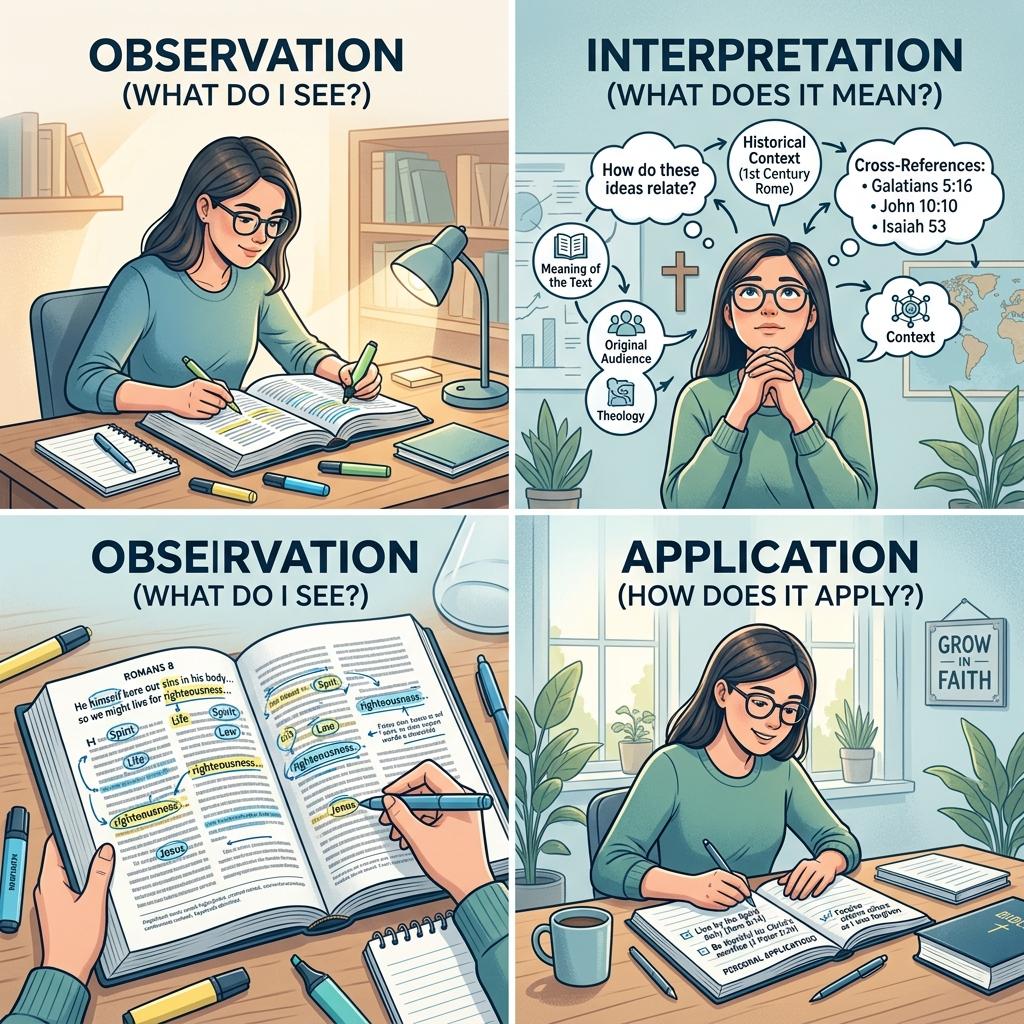
Inductive Bible study is the foundation of all serious Scripture engagement. Instead of reading a passage and accepting a commentary's interpretation, inductive study teaches you to investigate Scripture yourself—asking questions, examining details, and discovering what the text actually says before considering what it means.
The inductive method follows three essential steps: Observation (What does the text say?), Interpretation (What does it mean?), and Application (How does it apply to my life?). This systematic approach prevents you from importing preconceived ideas into Scripture and instead allows Scripture to speak on its own terms.
Whether you're preparing a Bible study lesson, deepening your personal faith, or simply wanting to understand Scripture more thoroughly, inductive study provides a reliable framework. This complete guide walks you through the entire process—from selecting a passage through discovering its meaning and applying its truth to your life.
What Is Inductive Bible Study?
Inductive Bible study is a method of examining Scripture by letting the text speak for itself rather than relying primarily on commentaries or outside interpretations. The word "inductive" describes the process: you gather observations from the text itself, then draw conclusions from those observations.
How Inductive Study Differs from Other Methods
Inductive study is distinct from other Bible study approaches:
- vs. Devotional study: Devotional study focuses on personal spiritual response; inductive focuses on understanding what the text says.
- vs. Topical study: Topical study traces a theme across all Scripture; inductive examines a single passage in depth.
- vs. Word study: Word study analyzes individual words; inductive examines an entire passage and its relationships.
- vs. Character study: Character study traces a person throughout Scripture; inductive examines what a passage reveals about that person.
The relationship: These methods complement each other. Inductive study provides the detailed foundation; other methods build on that foundation by expanding the scope. If you want to combine these methods, check our comprehensive Bible Study Methods Guide.
Why Inductive Study Matters
Inductive study develops your ability to read Scripture accurately and think critically about its meaning. Rather than passively accepting interpretations, you become an active investigator of God's Word. This approach produces:
- Personal conviction: When you discover meaning yourself, you own it spiritually.
- Scripture literacy: You learn how to read the Bible, not just read the Bible.
- Spiritual independence: You develop skill to interpret Scripture without always depending on others' explanations.
- Deeper understanding: Careful observation reveals nuances that casual reading misses.
- Confidence in God's Word: Direct engagement with Scripture strengthens your trust in its reliability.
The Three Movements of Inductive Study: Observation, Interpretation, Application
Inductive study follows a logical progression from observation through interpretation to application.
Movement 1: Observation (What Does the Text Say?)
Observation is asking: What do I actually see in this passage? Not what do I think it means, but what does it literally say?
Key observation questions:
- Who is speaking? Who is being addressed?
- What is happening? What is the situation?
- When does this occur? What's the historical setting?
- Where does this take place? What's the geographical context?
- Why is this being said or done? What's the motivation?
- How does this happen? What's the process or method?
Observation techniques:
- Read multiple times: First read for overall impression, then read again slowly, examining details.
- Mark patterns: Highlight repeated words, phrases, or concepts.
- Note transitions: Watch for words like "therefore," "but," "because," "so that" that show logical connections.
- Observe structure: How is the passage organized? Does it have a beginning, development, and conclusion?
- Identify genre: Is this narrative, poetry, epistle, prophecy, parable? Genre affects how you read.
- Track pronouns and references: Who does "he," "you," "they" refer to?
- Note questions or commands: What is the author asking or instructing?
Example - Mark 4:35-41 (Jesus Calms the Storm):
Observations:
- Setting: Evening, on the sea, in a boat with disciples.
- Situation: A great wind/storm arises.
- Jesus's state: Sleeping on a cushion.
- Disciples' response: Fear, waking Jesus, asking "Don't you care?"
- Jesus's response: Rebukes the wind, speaks peace, asks why they're afraid.
- Disciples' response: Great fear, questioning who Jesus is.
- Repeated word: "Fear" appears multiple times in different forms.
Movement 2: Interpretation (What Does It Mean?)
Interpretation is asking: Based on what I observed, what is the author communicating? What is the meaning of this passage?
Key interpretive questions:
- What is the main point of this passage?
- How do the parts relate to the whole?
- What does this reveal about God? About humanity? About the relationship between them?
- What is the author's purpose in including this passage?
- How does this passage fit within its larger context (the chapter, book, or testament)?
- What would the original audience have understood from this?
Interpretation principles:
- Context is crucial: Always consider the surrounding passages, the book's theme, and the author's purpose.
- Scripture interprets Scripture: How do other passages address the same topic or use the same language?
- Historical-cultural context matters: Understanding first-century Jewish or Greco-Roman culture illuminates meaning.
- Grammar and sentence structure reveal relationships: How words connect shows how ideas relate.
- The most natural reading is usually correct: Don't strain to find hidden meanings when the straightforward reading makes sense.
- Authorial intent matters more than your feelings: What did the author intend to communicate, not what you wish the passage meant?
Example - Mark 4:35-41 interpretation:
Interpretations:
- The repeated theme of fear suggests the passage is about faith versus fear.
- Jesus's question "Why are you still afraid?" combined with "Do you still have no faith?" indicates the connection between fear and faith.
- The disciples' amazement at Jesus's authority over nature suggests the passage reveals Jesus's identity and power.
- Main point: In crisis, faith in Jesus's power and presence should overcome fear.
Movement 3: Application (How Does It Apply?)
Application is asking: Now that I understand what this passage means, how does it shape how I think, believe, and live?
Key application questions:
- What does this passage teach about God? How should that change my view of Him?
- What does this passage teach about how to live? What principle applies to my circumstances?
- What does this passage challenge in my thinking or behavior?
- How do I need to respond to this truth?
- What specific change should I make based on this understanding?
Application principles:
- Application flows from interpretation: Don't apply what you haven't interpreted correctly.
- Look for universal principles, not just specific commands: A passage about Jesus calming a storm teaches about trusting Jesus in crisis, not literally expecting storms to cease.
- Application can be personal or communal: Some applications affect your individual faith; others affect how you relate to God's people.
- Obedience matters: Application isn't complete until you determine to actually do what the passage requires or teaches.
- Don't over-apply: Not every detail has a spiritual lesson.
Example - Mark 4:35-41 application:
Possible applications:
- When facing crises, I should trust Jesus's power and presence rather than giving in to fear.
- I should examine where my faith is weak and actively strengthen my trust in Jesus.
- I should speak words of faith to others in fear, pointing them to Jesus's authority.
- I should remember that Jesus's presence doesn't eliminate storms, but it transforms how I face them.
Analytical Frameworks for Inductive Study
While observation, interpretation, and application provide the overall structure, several frameworks help organize your detailed analysis.
SOAP Method (Simple Framework)
S - Scripture: Write out the passage or note the reference.
O - Observation: Record what you observe—who, what, when, where, why, how.
A - Application: Write how this applies to your life.
P - Prayer:Pray about what you've learned.
This simple framework takes 20-30 minutes and works well for daily Bible study.
5R Method (Deeper Framework)
Read: Read the passage multiple times in different translations.
Reflect: Write observations and questions about what you see.
Record: Document key words, patterns, and connections.
Research: Investigate the historical-cultural context and cross-references.
Respond: Write your interpretation and application.
This framework typically takes 1-2 hours and produces deeper understanding.
Narrative Analysis (For Story Passages)
For passages that tell stories (parables, Gospel narratives, Old Testament accounts), analyze:
- Characters: Who appears and what do we learn about them?
- Conflict: What problem or tension drives the story?
- Climax: What is the turning point?
- Resolution: How is the conflict resolved?
- Point: What is the author communicating through this story?
Epistolary Analysis (For Letter Passages)
For passages from Paul, James, 1 John, and other epistles, analyze:
- Occasion: Why is the author writing?
- Problem: What issue is being addressed?
- Solution: What instruction or truth does the author provide?
- Implication: What does this mean for the original audience and for us?
Essential Tools for Free Inductive Study
You don't need expensive software to do inductive Bible study. Free tools provide everything necessary:
| Tool | Best For | Strengths | Learning Curve |
|---|---|---|---|
| BibleHub.com | Concordance, translations, cross-references | Multiple translations, Strong's lexicon integration, completely free | Very low |
| BlueLetterBible.org | Deeper contextual analysis, original languages | Interlinear tools, comprehensive commentaries, study resources | Low-moderate |
| Bible.com (YouVersion) | Mobile study, note-taking, highlighting | Cross-device sync, community sharing, structured reading plans | Very low |
| BibleGateway.com | Side-by-side translation comparison | Massive library of translations, easy navigation | Very low |
Three Inductive Study Workflows
Quick Inductive Study (30-45 minutes)
Goal:Understand a passage's basic meaning; suitable for daily study or discussion prep.
- Select and read passage (5 min): Read in one translation, getting the basic sense.
- Observe key elements (10 min): Who, what, when, where, why, how.
- Interpret main point (10 min): What is the author primarily communicating?
- Apply to your life (5 min): How does this apply today?
Result: Basic understanding and one personal application.
Standard Inductive Study (1-1.5 hours)
Goal: Thorough understanding suitable for teaching or study group preparation.
- Read in multiple translations (10 min): Observe differences in how translations render the passage.
- Detailed observation (20 min): Mark patterns, transitions, repeated words, structure.
- Research context (15 min): Use BibleHub or Blue Letter Bible to check cross-references and word meanings.
- Write interpretation (10 min): Document what the passage means based on your observations.
- Develop applications (10 min): Write 2-3 ways this applies to your life or ministry.
Result: Well-reasoned understanding and multiple applications.
Deep Inductive Study (2-3 hours)
Goal: Scholarly-level understanding suitable for sermons, teaching, or mentoring.
- Read in multiple translations and versions (15 min): Compare word-for-word (ESV, KJV, NKJV) with thought-for-thought (NIV, NLT) translations.
- Exhaustive observation (30 min): Document every detail—grammar, structure, word choices, literary devices.
- Examine original language (30 min): Use BlueLetterBible to check Greek or Hebrew words and grammar.
- Research historical-cultural context (20 min): Understand first-century background, customs, assumptions.
- Study cross-references extensively (20 min): See how Scripture interprets itself on this passage's topic.
- Write comprehensive interpretation (20 min): Synthesize observations into a thorough explanation.
- Develop layered applications (15 min): Consider personal, communal, and universal applications.
Result: Deep understanding grounded in original languages and historical context.
Examples Across Passage Types
Inductive study works across all types of biblical passages. Here's how to approach different genres:
- Narrative Passages (Mark 4:35-41, Luke 15:11-32): Focus on story elements: characters, conflict, climax, resolution. Ask what the story reveals about God and how people should respond to Him. Notice details the author includes intentionally.
- Epistolary Passages (Romans 8:28-39, 1 John 3:1-10): Focus on logical connections: how does one sentence relate to the next? Track the argument. Ask why the author is writing and what specific problem he's addressing.
- Poetic Passages (Psalm 23, Philippians 2:5-11): Focus on literary devices: metaphor, parallelism, rhythm. Notice what's emphasized through repetition. Consider emotional and spiritual tone, not just literal meaning.
- Prophetic Passages (Isaiah 53, Revelation 21:1-4): Focus on imagery and symbolism: what do the images represent? Consider the original context—what would the original audience understand? Track how the passage develops or unfolds.
- Wisdom Passages (Proverbs 3:5-6, James 3:1-12): Focus on principles and contrasts: what universal truth is being taught? Notice contrasts between wise and foolish approaches. Consider how the principle applies broadly, not just in one situation.
Frequently Asked Questions
Is inductive study better than using commentaries?
Inductive study and commentaries serve different purposes. Inductive study develops your ability to read Scripture and discover meaning yourself. Commentaries provide scholarly insight and historical context. The ideal approach: do inductive study first to form your own understanding, then consult commentaries to refine and deepen your interpretation.
How much time should I spend on observation versus interpretation?
For a quick study, spend about half your time on observation, half on interpretation and application. For deeper study, spend 40% on observation, 40% on research and interpretation, 20% on application. Thorough observation prevents misinterpretation.
Should I use only one Bible translation for inductive study?
Use at least two translations. A word-for-word translation (ESV, KJV, NKJV) shows the text's exact structure; a thought-for-thought translation (NIV, NLT) shows the meaning in modern English. Comparing them reveals nuances.
What if I observe something that seems to contradict another passage?
First, make sure you've interpreted both passages correctly in their context. Apparent contradictions often disappear with careful interpretation. If contradiction remains, remember that Scripture doesn't contradict itself—you may be misunderstanding one or both passages. Consult multiple translations and check cross-references.
How detailed should my observations be?
Detailed enough to discover meaning. Sometimes a single read reveals the main point. Other passages require extensive observation to understand structure and relationships. As a rule: if you're not discovering anything new after 15-20 minutes of observation, you've observed enough.
Can I do inductive study without knowing original languages?
Absolutely. Free tools like BlueLetterBible provide word definitions and grammatical information even if you don't know Greek or Hebrew. Comparing translations shows how language functions. You can do thorough inductive study without knowing the original languages.
What's the difference between application and interpretation?
Interpretation answers "What does this mean?" Application answers "What should I do about it?" First understand what the passage means; then determine how that meaning applies. Applying a misunderstood passage creates wrong living.
Should I study long passages or short passages inductively?
Start with shorter passages (a paragraph, 5-15 verses). As you develop skill, tackle longer passages. A complete story, a full argument in an epistle, or a complete poem are natural units for study, even if they're longer.
Conclusion
Inductive Bible study is a learnable skill that transforms how you engage Scripture. By systematically observing what a passage says, determining what it means, and applying its truth to your life, you develop both Scripture literacy and spiritual maturity.
The method is straightforward: observation (What does it say?), interpretation (What does it mean?), and application (How does it apply?). The tools are free: BibleHub, Blue Letter Bible, Bible.com, and Bible Gateway provide everything you need. The frameworks are flexible: whether you have 30 minutes or 3 hours, inductive study produces meaningful understanding.
Begin with a passage that interests you. Use one of the workflows appropriate to your available time. Discover how careful, systematic study of Scripture produces both understanding and transformation. If you want to expand your study into other techniques, check our comparison of the Geneva Bible vs KJV or understand the history behind the Geneva Bible 1560 to see how historical contexts enrich your observations.
Related Study Guides
- Topical Bible Study Guide
Learn how to trace themes, doctrines, and concepts across all books of the Bible.
- Bible Character Study Guide
Trace biblical figures and their spiritual transformation using timelines.
- Devotional Bible Study Guide
Master devotional Bible study with practical techniques for journaling and prayer.
- How to Do Word Study Guide
Learn word study step-by-step using free tools like BibleHub and BlueLetterBible.