
Creating Your Personal Bible Study Plan: A Guide to Designing Sustainable Scripture Study for Your Season of Life
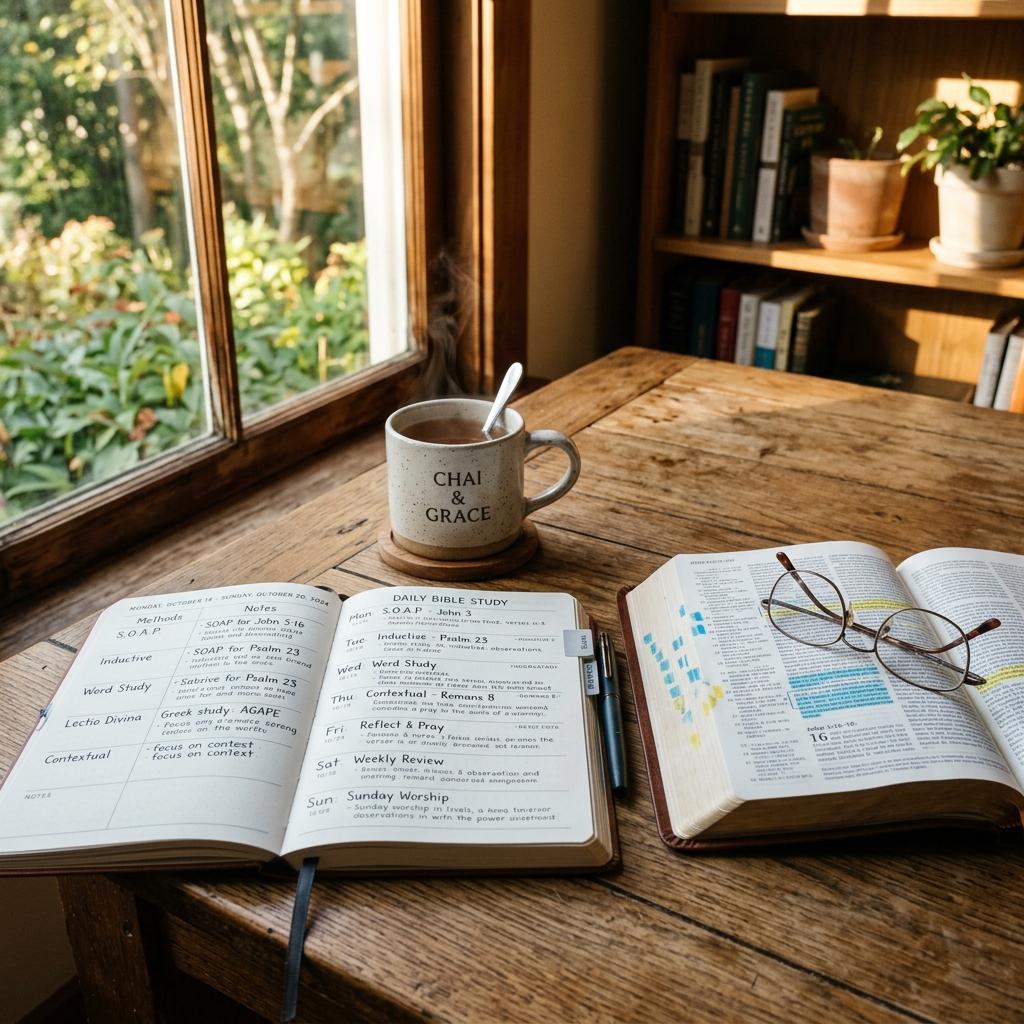
The most comprehensive Bible study plan is worthless if you don't maintain it. The most sophisticated methods produce zero transformation if you never begin. The real challenge isn't learning what could work—it's designing what will work for your actual life right now.
This guide helps you create a personalized Bible study plan that fits your season of life, respects your time constraints, integrates the methods you've learned, and builds sustainable rhythms you can actually maintain. Whether you have 20 minutes daily or can dedicate two hours weekly, whether you're a student, a parent, a professional, or retired, whether you study alone or with others, you can design a plan that works.
The key is alignment: matching study depth to available time, selecting methods appropriate to your goals, and building flexibility for life's inevitable disruptions.
Part 1: Assessing Your Current Season of Life
Identifying Your Life Stage Framework
Your current season fundamentally shapes what's realistic in Bible study commitment. Honest assessment prevents the guilt-cycle of unrealistic plans.
Student Season (High School, College, Early Career Training)
- Characteristics: High intellectual capacity, moderate-to-high free time, intense focus periods, irregular schedules.
- Realistic commitment: 20-45 min daily, flexible timing.
- Best methods: Word study, inductive study (satisfy intellectual curiosity), topical study (address faith questions).
- Study location: Dorm, library, campus café, commute time.
- Frequency: Daily or 5x weekly most sustainable.
- Integration opportunity: Study alongside coursework; allow academic challenges to prompt theological questions.
Early Professional/Dual-Income Season (25-40 years old)
- Characteristics: Career demands, possibly young family, commute time, fragmented schedule, mental fatigue.
- Realistic commitment: 15-30 min daily OR 1-2 hours 2-3x weekly.
- Best methods: Devotional study (spiritual centering), character study (application to professional relationships), inductive study (shorter passages).
- Study location: Before work, lunch break, commute, early morning.
- Frequency: 4-5x weekly minimum for daily format; 2-3x weekly for longer sessions.
- Integration opportunity: Study passages addressing work ethics, relationships, stress, ambition.
Parenting Young Children (Birth-Age 10)
- Characteristics: High time demands, frequent interruptions, mental fatigue, irregular sleep, limited solitude.
- Realistic commitment: 10-20 min daily (fragmented) OR 1-2 hours 1-2x weekly (when childcare available).
- Best methods: Devotional study (spiritual survival), topical study (parenting, faith modeling, spiritual formation).
- Study location: Very early morning (before children wake), naptime, after bedtime, scheduled study times with childcare swap.
- Frequency: 3-4x weekly is realistic; consistency matters more than length.
- Integration opportunity: Study passages on patience, hope, faithfulness; pray for children; model faith intentionality.
Parenting Teenagers (Ages 11-18)
- Characteristics: Moderate time demands, possible family study opportunities, intellectual capacity for deeper study, teen spiritual questions.
- Realistic commitment: 20-30 min daily OR 1.5-2 hours 2-3x weekly, plus family study.
- Best methods: All methods viable; family study strengthens faith transmission.
- Study location: Home, library, coffee shop (teen driver available), family table.
- Frequency: 4-5x weekly personal study; 1-2x weekly family study.
- Integration opportunity: Study passages addressing identity, temptation, relationships, future direction; discuss with teens.
Empty Nest / Mature Professional (40-60 years old)
- Characteristics: Moderate time freedom, possible caregiving responsibilities, deep faith questions, teaching/mentoring opportunities.
- Realistic commitment: 30-60 min daily OR 2-3 hours 2-3x weekly.
- Best methods: All methods, including advanced synthesis (depth matched to available time).
- Study location: Home office, library, retreat setting, church study group.
- Frequency: 5-6x weekly with flexibility.
- Integration opportunity: Study for teaching, mentoring, spiritual deepening; explore complex theological questions.
Retirement / Senior Years (60+ years old)
- Characteristics: Significant time freedom, possible health constraints, deep wisdom-seeking, legacy focus.
- Realistic commitment: 1-3 hours daily (flexible timing).
- Best methods: All methods with emphasis on synthesis, topical research, and theological integration.
- Study location: Home, library, retreat centers, study groups.
- Frequency: Daily study with flexibility for health needs.
- Integration opportunity: Create personal commentaries, mentor younger believers, synthesize lifetime of faith experience.
Life Stage Reality Check
Before designing your plan, honestly assess:
- Time Available: How much uninterrupted time realistically exists in my week? What times are reliably available (not just theoretically possible)? What time commitments are non-negotiable (work, family, health, sleep)?
- Energy Level: When am I mentally sharpest (early morning, evening, afternoon)? How much can I study when mentally fatigued? Do I need variety or can I sustain single-focus study?
- Study Environment: Where can I study uninterrupted for my intended duration? Is group study or solo study more realistic? What tools/resources do I have access to?
- Motivation Sources: What prompts me to open Scripture (crisis, discipline, joy, curiosity, obligation)? What outcomes would make study feel worthwhile (spiritual depth, teaching preparation, personal transformation, intellectual engagement)? What has disrupted study plans before?
Part 2: Building Your Study Plan Framework
Step 1: Select Your Primary Time Commitment
Choose one category that matches your realistic availability:
Minimal Time Plan (15-20 min daily)
- Best for: Busy professionals, young parents, students with demanding schedules.
- Structure: One method per day, rotating focus.
- Realistic goal: Devotional depth + one secondary method.
- Tools: Bible.com app for quick access.
- Frequency: 5-6 days weekly (one flexible day).
Example Week: Monday: Devotional study | Tuesday: Word study on one term | Wednesday: Devotional study | Thursday: Topical theme tracing | Friday: Devotional study | Saturday: Character reflection | Sunday: Rest.
Moderate Time Plan (30-45 min daily)
- Best for: Professionals with morning/evening space, students, parents of school-age children.
- Structure: Two methods combined daily OR one method with depth.
- Realistic goal: Solid single-method study OR synthesis of two approaches.
- Tools: BibleHub + BlueLetterBible bookmarked, Bible.com for reading.
- Frequency: 4-5 days weekly.
Example Week: Monday: Inductive study (40 min) | Tuesday: Word study (35 min) | Wednesday: Rest day | Thursday: Topical research (45 min) | Friday: Devotional + Character study (40 min) | Saturday: Synthesis review (30 min) | Sunday: Worship-focused reflection.
Extended Time Plan (1-2 hours 2-3x weekly)
- Best for: Serious students, empty-nesters, early retirees, study group participants.
- Structure: Comprehensive single-passage study OR thematic research.
- Realistic goal: Advanced synthesis, genre-specific analysis, cultural research.
- Tools: Full access to BibleHub, BlueLetterBible, Bible.com, research notes.
- Frequency: 2-3 focused sessions weekly.
Example Week: Monday: Rest | Tuesday: Deep study session (90 min) - Romans 5:12-21 with full synthesis | Wednesday: Rest | Thursday: Rest | Friday: Deep study session (90 min) - topical research on justification | Saturday: Rest | Sunday: Devotional reflection (30 min) + study group (60 min).
Step 2: Select Your Core Methods
From the four foundational methods, choose which will anchor your plan:
Must-Include Methods (Recommended):
- Devotional study - Spiritual formation and personal application (include this unless study is purely academic).
- Inductive study - Foundational observation and interpretation skill.
Choose 1-2 Additional Methods:
- Word study - For deeper linguistic understanding.
- Topical study - For thematic understanding across Scripture.
- Character study - For biographical and relational learning.
- Advanced synthesis - For sophisticated integration (requires time).
Step 3: Design Your Study Rhythm
Match study depth to your life season:
- For Minimal Time (15-20 min): Rotate focus weekly (Week 1: Devotional, Week 2: Word study, Week 3: Topical/Character, Week 4: Devotional + synthesis).
- For Moderate Time (30-45 min): 4-week rotation: (Week 1: Inductive + Devotional, Week 2: Word study + Inductive, Week 3: Topical + Word study, Week 4: Character or synthesis + all methods).
- For Extended Time (1-2 hours 2-3x weekly): Session 1: Inductive study (60-90 min), Session 2: Topical/Word study (90 min), Session 3: Integration/Group study (60-90 min). Or quarterly specialization (one book/theme over 12 weeks).
Step 4: Select Your Tools
Using only free tools, choose your primary resources:
- For Quick Access & Multiple Translations: Bible.com (YouVersion app) - Read in Geneva Bible, KJV, ESV, NKJV, NIV | Bible Gateway - Quick lookup, study notes, audio.
- For Word Study: BibleHub.com Lexicon - Greek/Hebrew word investigation | BlueLetterBible.org - Lexical tools, interlinear Bible | Strong's Online - Concordance and word definitions.
- For Topical Research: BlueLetterBible.org Topical Index | Bible.com Study Plans on themes | BibleHub Cross-references.
- For Commentaries & Background: BibleHub.com Commentary section | BlueLetterBible Study Tools | Bible.com Study Notes.
Part 3: Life Stage Study Plans (Detailed Examples)
Student Season Plan: Comprehensive Growth Focus
Available Time: 25-40 min daily, 5-6 days weekly | Methods: All four | Tools: BibleHub, BlueLetterBible, Bible.com | Goal: Build study skill foundation while addressing faith questions.
- Monday: Inductive study of assigned passage (30 min) - observation + interpretation.
- Tuesday: Word study on key terms (25 min) - 2-3 terms, lexicon research.
- Wednesday: Devotional reflection (20 min) - personal application, prayer.
- Thursday: Topical research (35 min) - theme tracing, synthesis with other passages.
- Friday: Character study (30 min) - biographical narrative or relational development.
- Saturday: Integration review (25 min) - synthesize week's learning, theological synthesis.
- Sunday: Group study or worship reflection.
Quarterly Focus: Q1: Gospel of Mark | Q2: Romans | Q3: Psalms & Proverbs | Q4: Elective focus.
Parent of Young Children Plan: Spiritual Survival & Modeling
Available Time: 15-20 min daily (fragmented) + 1-1.5 hours 1x weekly (with childcare swap) | Methods: Devotional (primary) + Character study + Topical (for parenting themes) | Tools: Bible.com app (quick access), BibleHub (for deeper dives on designated study day) | Goal: Personal spiritual formation + faith modeling for children.
- Daily Study (10-15 min): Morning devotional, Scripture reading in one of five translations, 3-5 minute reflection on personal application, prayer.
- Weekly Deep Study (1-1.5 hours, 1x weekly): One extended session with childcare coverage, inductive study of assigned passage, word study on 2-3 key terms, application to parenting situation.
Themed Monthly Focus: Month 1: Parental faith and modeling | Month 2: Character development | Month 3: Hope and endurance | Month 4: Love and patience.
Empty Nester Plan: Depth & Teaching Focus
Available Time: 45-60 min daily, 5-6 days weekly, plus 2-3 hour monthly study sessions | Methods: All methods with advanced synthesis emphasis | Tools: Full access to BibleHub, BlueLetterBible, Bible.com | Goal: Theological depth, teaching preparation, personal mastery.
- Monday: Inductive study of assigned book passage (50 min) - full observation, interpretation.
- Tuesday: Word study (50 min) - 3-5 key terms, lexicon research, translation comparison.
- Wednesday: Topical research (55 min) - theme development across testaments, doctrinal synthesis.
- Thursday: Rest day or light devotional (15 min).
- Friday: Character study (50 min) - biographical analysis, development patterns.
- Saturday: Advanced synthesis (60 min) - integrate week's learning, cultural-historical research.
- Sunday: Teaching preparation or group study discussion (60 min).
Retirement Plan: Legacy & Synthesis Focus
Available Time: 1-3 hours daily (flexible timing) | Methods: All methods with emphasis on synthesis and theological integration | Tools: All tools, including developing personal library | Goal: Theological mastery, mentoring others, creating legacy resources.
- Daily Study (flexible): Morning (1-1.5 hours) - primary study of assigned passage or theme. Afternoon (optional 45-60 min) - additional research. Evening (optional 30 min) - devotional reflection.
- Extended Projects: Quarterly - complete study of biblical book with all methods. Yearly - develop specialized expertise in one theme or period. Ongoing - create personal commentary.
Part 4: Maintaining Your Plan
The best plan fails without sustainability practices:
- Flexibility Principle: Build in automatic adjustments for disruption. Shift to simpler methods temporarily rather than abandoning study when life gets chaotic.
- Accountability Structure: External accountability strengthens consistency. Partner check-ins, study groups, or teaching commitments help you stay on track.
- Progress Documentation: Tracking creates motivation. Maintain a study journal, mark completed books, and celebrate finished projects.
- Seasonal Adjustments: Plans adjust as life stages shift. Review your plan annually, simplifying during crisis periods and deepening during stable seasons.
Common Pitfalls & Solutions
- Pitfall: Overambitious Planning → Solution: Choose realistic time commitment for your actual season, not your ideal season.
- Pitfall: Method Monotony → Solution: Rotate methods regularly. Change focuses monthly or quarterly to keep study engaging.
- Pitfall: Guilt-Driven Resumption → Solution: When disrupted, simply resume without catching up. Start fresh where you left off.
- Pitfall: Tool Paralysis → Solution: Choose 2-3 primary tools and learn them well. Free tools are sufficient.
- Pitfall: Isolation → Solution: Include at least monthly group study or study community for shared growth.
Frequently Asked Questions
Should my plan include the same passage every year?
Not necessarily. Varied study of different passages creates broader biblical understanding. However, re-studying a favorite passage yearly with new methods reveals new depth.
What if my life stage changes mid-year?
Adjust your plan immediately rather than abandoning study. Better to reduce to 15 minutes than stop entirely. You can increase again when circumstances improve.
Can I study in a group as my primary plan?
Yes, but supplement group study with some personal study. Group study provides accountability and different perspectives; personal study deepens individual transformation.
How do I know if my plan is working?
Your plan is working if you maintain consistency, you're developing Bible knowledge, and Scripture is transforming your thinking and behavior. A plan you actually follow beats a perfect plan you don't.
Should my plan be the same year-round?
Not necessarily. Seasonal variation (deeper study in summer; simpler devotional in winter) can sustain long-term engagement. Annual reviews allow plan adjustments.
What if I fail to stick to my plan?
Every believer experiences disrupted plans. Never resume by catching up or feeling guilty. Simply resume tomorrow. God's grace covers inconsistency; restart without condemnation.
Conclusion: Start Where You Are
You don't need a perfect plan. You need a realistic plan you'll actually follow. You don't need unlimited time. You need consistency with available time. You don't need every tool. You need 2-3 tools you understand well.
Your personal Bible study plan is unique because your season of life is unique. Your capacity, your circumstances, your questions, and your goals are yours alone. Honor that specificity by designing a plan that actually fits your reality, not your ideals.
This week, choose your time commitment, select your core methods, and begin. If you are exploring translation history to enrich your studies, look at our comparative review of the Geneva Bible vs KJV or understand the legacy behind the King James Version History & Translation.
Related Study Guides
- Bible Study Methods: Complete Guide
Master four powerful Bible study methods—inductive, word study, topical & devotional.
- Inductive Bible Study Guide
Study passages deeply using observation, interpretation, and application.
- Advanced Bible Study Techniques
Learn advanced techniques for synthesizing methods and performing genre analysis.
- How to Do Word Study Guide
Learn word study step-by-step using free tools like BibleHub and BlueLetterBible.