
Inductive Study Method: Advanced Observation Techniques, Rigorous Interpretation, and Integration with Historical-Cultural Context
I. Introduction: Inductive Study as Hermeneutical Foundation
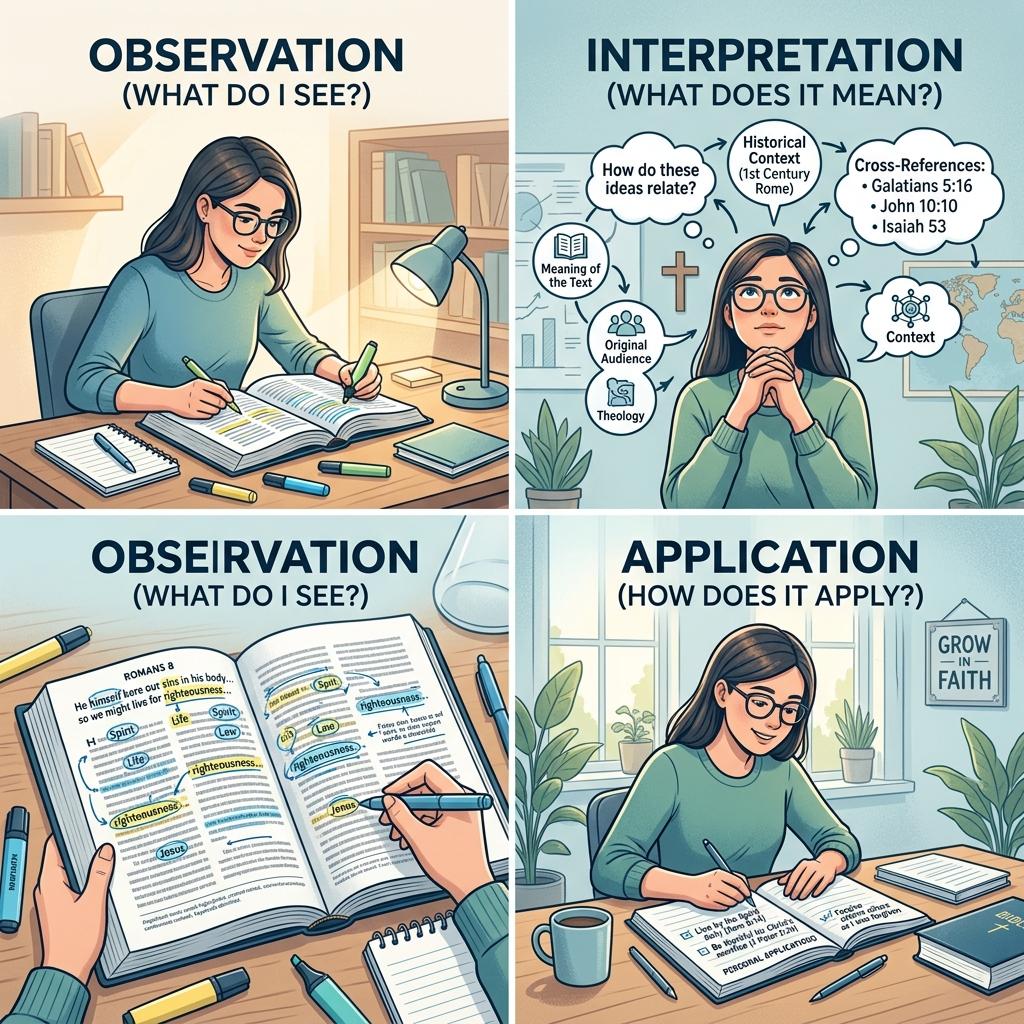
The Inductive Study Method represents the foundational hermeneutical approach from which all other study methods build. In its simplest form, the method follows three sequential phases: Observation (What does the text say?), Interpretation (What does it mean?), and Application (What does it mean for my life?). Yet when practiced with sophistication and rigor, the Inductive Method becomes far more complex and powerful than this simple formula suggests.
Advanced practitioners recognize that Inductive study is not merely casual text reading but systematic, disciplined observation that precedes and grounds interpretation. The method insists that interpretation must be anchored in careful observation of what the text actually says rather than what we assume it says or what we hope it means. This foundational commitment to textual fidelity, while apparently simple, demands rigorous discipline and constant vigilance against the human tendency toward eisegesis—reading meaning INTO the text rather than getting meaning FROM the text.
The Inductive Method's power emerges when grounded in comprehensive understanding of biblical historical context, cultural practices, theological development, and original languages. Without this grounding, even careful observation remains superficial. With this grounding, inductive observation reveals layers of meaning that transform understanding.
The Relationship Between Observation and Truth
At its core, the Inductive Method rests on conviction that careful observation of what texts actually say, rather than theological presumptions about what they should say, is the proper path to understanding Scripture's truth. This is not to claim that observation is theory-neutral or that interpreters approach texts without presuppositions—they do not. Rather, it is to claim that disciplined observation of actual textual content, even when conducted by interpreters with theological commitments, enables encounter with what the text genuinely teaches.
The NKJV's rendering of 2 Timothy 2:15—"Be diligent to present yourself to God, approved, a worker who does not need to be ashamed, rightly dividing the word of truth"—establishes observation-based study as spiritual discipline. The ESV's rendering similarly emphasizes careful handling of Scripture: "Do your best to present yourself to God as one approved, a worker who has no need to be ashamed, rightly handling the word of truth." The Geneva Bible's "Study to shew thyself approved unto God, a workman that needeth not to be ashamed, rightly dividing the word of truth" identifies this careful study as essential spiritual work.
The phrase "rightly dividing" (orthotomeo) literally means "cutting straight"—implying that handling Scripture properly requires precision and care, not careless handling that distorts the text. This precision begins with rigorous observation.
II. Advanced Observation: Beyond Casual Reading
What Observation Actually Means
Observation, in the Inductive Method's technical sense, differs fundamentally from casual reading. Casual reading captures general impressions and main ideas. Observation involves systematic, disciplined examination of what the text actually says—the precise words, their relationships, their structures, their emphases, their repetitions, their absences.
Consider the opening of Matthew's Gospel. Casual reading might note "This is about Jesus's birth." Advanced observation notes far more: Matthew begins with genealogy (unusual for ancient narrative), traces Jesus's lineage through David and Abraham (theologically significant connections), includes four women in the genealogy (Tamar, Rahab, Ruth, Bathsheba—each with complicated backstory), repeatedly emphasizes that Joseph was not Jesus's biological father while Mary's role in conception is central, uses specific phrase "mother of Jesus" rather than just naming Mary.
The NIV's rendering of Matthew 1:16—"and Jacob the father of Joseph, the husband of Mary, of whom was born Jesus, who is called the Messiah"—employs unusual passive construction. The ESV similarly renders it: "and Jacob the father of Joseph the husband of Mary, of whom Jesus was born, who is called Christ." The NKJV reads: "And Jacob begat Joseph the husband of Mary, of whom was born Jesus who is called Christ." Notice that in each translation, the subject shifts—"Joseph the husband of Mary" is named, but the verb changes from "begat" (active, suggesting paternity) to "of whom was born Jesus" (passive, obscuring Joseph's role). This textual observation is crucial for recognizing Matthew's theological claim that Jesus's conception differs from normal human paternity.
Advanced observation notices what the text says and also what it notably does NOT say. Matthew does not name Jesus's biological father. Matthew emphasizes Joseph's righteousness and obedience despite his uncertainty and confusion. Matthew notes that Joseph did not consummate his marriage with Mary until after Jesus's birth. These observations form the basis for later interpretation about Jesus's unique conception.
Observation Under Different Textual Genres
Advanced observation recognizes that different genres require different observational approaches. Observing a narrative text (like a Gospel story) attends to plot structure, character development, dialogue, setting, sequence of events. Observing poetry (like Psalms) attends to parallelism, imagery, metaphor, repetition, rhythm. Observing legal material (like Leviticus) attends to case law structure, conditional formulations, penalties, underlying principles. Observing epistolary material (like Paul's letters) attends to rhetorical structure, argument development, emotional intensity, shifts in tone.
Consider observing Psalm 23. The Geneva Bible's rendering—"The LORD is my shepherd, I shall not want"—employs personal metaphor of divine relationship as shepherding. The NKJV similarly renders it: "The LORD is my shepherd; I shall not want." The ESV maintains: "The LORD is my shepherd; I shall lack nothing." The NIV offers: "The LORD is my shepherd, I lack nothing."
Advanced observation of this psalm notes: the speaker shifts from third person ("The LORD is my shepherd") to first person ("I shall not want"); the psalm moves from present security ("I shall not want") to past-tense experience ("thou preparedst a table before me in the presence of mine enemies") to future confidence ("I will dwell in the house of the LORD for ever"); the imagery shifts from shepherd-sheep to host-guest to inhabitant-dwelling; protective imagery (valley of the shadow of death, rod and staff) alternates with abundance imagery (green pastures, still waters, table, anointing, cup). Understanding the psalm requires observing these literary movements.
Observation Grounded in Historical-Cultural Context
The most sophisticated observation integrates understanding of ancient culture. Consider observing the foot-washing scene in John 13. Casual observation notes that Jesus washes disciples' feet. Advanced observation grounded in cultural understanding recognizes that foot-washing was servant's work in a culture where people wore open sandals on dusty roads. Observing that Jesus performs servant's work carries profound meaning that becomes clear only with cultural understanding.
The ESV's rendering of John 13:4-5—"he rose from supper. He laid aside his garments, and taking a towel, tied it around his waist. Then he poured water into a basin and began to wash the disciples' feet and to wipe them with the towel that was wrapped around him"—describes action that needs cultural context to understand fully. The NKJV's similar rendering emphasizes the action's reversal of normal roles—the master (Jesus) performs a slave's function. This revolutionary act becomes observable only when grounded in cultural understanding of social hierarchies.
III. The Three Phases of Inductive Study: Advanced Application
Phase One: Systematic Observation
Advanced observation employs several systematic techniques to ensure comprehensive analysis. Word-by-word examination involves careful attention to each word's placement, significance, and relationships. Why does the author use this word rather than synonyms? Notice that the NIV's rendering of John 1:1—"In the beginning was the Word, and the Word was with God, and the Word was God"—uses "Word" consistently. The NKJV similarly maintains consistency: "In the beginning was the Word, and the Word was with God, and the Word was God." Yet the Greek term logos carries multiple meanings (word, reason, logic, divine principle). Observing that John uses logos rather than a more specific term becomes significant for later interpretation of what John means by calling Jesus the Word.
Structural observation examines how the text organizes its content. Does the passage employ parallelism (common in Hebrew poetry)? Does it use repetition for emphasis? Does it build argument progressively? Does it employ chiasm (inverted parallelism, A-B-B-A structure)?
Consider observing Romans 1:16-17. The Geneva Bible renders it: "For I am not ashamed of the gospel of Christ: for it is the power of God unto salvation to every one that believeth; to the Jew first, and also to the Greek. For therein is the righteousness of God revealed from faith to faith: as it is written, The just shall live by faith." The structure moves from Paul's personal stance ("I am not ashamed"), to the gospel's power ("power of God unto salvation"), to its scope ("to every one that believeth"), to its audience priority ("Jew first, then Greek"), to its theological foundation ("righteousness of God revealed from faith to faith").
Observing this structure reveals Paul's argument: he begins personally (establishing his credibility), moves to universal claim (gospel's transformative power), specifies the mechanism (faith), notes the audience sequence (Jews first, reflecting historical priority), and grounds it in theological principle. This structural observation shapes interpretation—Romans is not merely abstract theology but Paul's personal proclamation grounded in conviction about gospel's power.
Observation of relationshipsexamines how elements connect. How do clauses relate to each other? Which ideas connect causally ("because," "therefore")? Which relate conditionally ("if," "then")? Which show contrast ("but," "yet")? The ESV's rendering of James 2:26—"For as the body apart from the spirit is dead, so faith apart from works is dead"—employs explicit parallel structure: "As X without Y is dead, so Z without W is dead." Observing this parallel structure shapes interpretation—James is arguing that faith relates to works as body relates to spirit.
Observation of what is emphasizedinvolves recognizing textual signals of significance. Repetition indicates emphasis. The NIV's rendering of Revelation 1:8—"'I am the Alpha and the Omega,' says the Lord God, 'who is, and who was, and who is to come, the Almighty'"—repeats the divine self-identification formula three times: "I am," "who is, and who was, and who is to come," "Almighty." This repetitive emphasis suggests the author wants readers to grasp the divine eternality and comprehensive power. Observation of such emphatic devices guides interpretation toward understanding author's priorities.
Phase Two: Rigorous Interpretation Grounded in Observation
Interpretation moves beyond observation to ask: What does this observed content mean? Yet the key principle is that interpretation must be grounded in and constrained by observation. Interpretation that contradicts observation or ignores observation is eisegesis—reading meaning into the text rather than getting meaning from the text.
Interpretation requires integrating context. Context operates at multiple levels. Immediate context involves the sentences and paragraphs surrounding a passage. Broader context involves the entire book. Canonical context involves how other passages in Scripture address similar subjects. Historical context involves understanding when and in what circumstances the text was written. Theological context involves understanding what theological debates or developments the author addresses.
Consider interpreting Jesus's saying in Matthew 16:25: "For whoever wants to save their life will lose it, but whoever loses their life for me will find it" (NIV). The NKJV renders it: "For whoever desires to save his life will lose it, but whoever loses his life for My sake will find it." The ESV similarly renders: "For whoever would save his life will lose it, but whoever loses his life for my sake will find it."
Immediate context shows Jesus has just predicted his own suffering and death, then called disciples to take up their cross and follow him. Broader context shows this teaching appears in all three Synoptic Gospels, suggesting it was central to Jesus's teaching. The saying employs paradox—losing to find, dying to live. Interpreting the saying requires recognizing that "save/lose his life" refers not merely to physical death but to fundamental orientation—whether one clings to self-preservation or surrenders self to follow Jesus. This interpretation emerges from careful observation of context and textual signals.
Interpretation requires avoiding eisegesis. This is the constant danger of inductive study—letting one's theological commitments override what the text actually says. A student believing that Scripture teaches predestination might read predestination into Romans 8:29 without carefully observing what Paul actually says. A student believing Scripture must prohibit women in ministry might read that prohibition into 1 Corinthians 11:3 without attending to Paul's actual argument about head covering and prophecy.
Avoiding eisegesis requires intellectual humility—willingness to allow texts to say what they actually say, even when that challenges one's expectations. The NKJV's rendering of Mark 3:21—"And when his friends heard of it, they went out to lay hold on him: for they said, He is beside himself"—reports that Jesus's family thought he was "out of his mind" or "beside himself." This unflattering portrayal of Jesus's family might seem like it should be hidden or interpreted away, yet careful observation shows Mark includes it deliberately. Avoiding eisegesis means accepting this observation and interpreting it rather than avoiding it.
Phase Three: Application—From Understanding to Transformed Living
Application moves from understanding what the text means to asking what difference this understanding makes for one's life and practice. Yet application grounded in careful observation and rigorous interpretation differs significantly from sentimental or subjective application that ignores textual meaning.
Consider applying Jesus's teaching about loving enemies (Matthew 5:43-48). The NIV renders it: "You have heard that it was said, 'Love your neighbor and hate your enemy.' But I tell you, love your enemies and pray for those who persecute you." The NKJV similarly renders: "You have heard that it was said, 'You shall love your neighbor and hate your enemy.' But I say to you, love your enemies, bless those who curse you, do good to those who hate you, and pray for those who spitefully use you and persecute you."
Application cannot mean "ignore the meaning Jesus taught and apply whatever comes to mind." Rather, application must be grounded in the observed teaching. Jesus explicitly calls for love toward enemies and prayer for persecutors. Application asks: How does this teaching reshape my relationships? When I encounter someone I naturally oppose or dislike, how does Jesus's command affect my response? Rather than sentimentality, this is rigorous application grounded in textual meaning.
IV. Complex Observational Challenges and Sophisticated Solutions
Challenge One: Textual Variants and Translation Differences
Advanced observation recognizes that observation is complicated by textual variants (where ancient manuscripts differ) and translation choices (where different translations render the same Greek/Hebrew differently). Rather than these complexities being obstacles, they become opportunities for deeper observation and understanding.
Consider 1 John 3:1. The NKJV renders it: "Behold, what manner of love the Father has bestowed upon us, that we should be called children of God!" The ESV similarly renders: "See what kind of love the Father has given to us, that we should be called children of God." The NIV reads: "See what great love the Father has lavished on us, that we should be called his children!" The Geneva Bible's "Behold what manner of love the Father hath showed unto us, that we should be called the sons of God" uses "sons" where modern translations use "children."
Observing these translation differences illuminates nuance. The term tekna(Greek) means "children" or "offspring." The question of whether to emphasize "sons" (which carries certain theological weight in biblical theology about inheritance and covenant) or "children" (which emphasizes relationship broadly) reflects interpretive choices. Advanced observation notes these translation choices and what they reveal about how translators understand the theological significance.
Challenge Two: Understanding Genres' Observational Requirements
Different genres require attentiveness to different observational features. Observing parables requires understanding that parables are teaching devices, not necessarily literal accounts, and that not every detail carries theological significance. Observing poetry requires understanding that poetic language employs metaphor, hyperbole, and imagery in ways that differ from literal statement.
Consider observing the Parable of the Sower (Matthew 13:1-23). The NKJV's initial rendering describes seed falling on four types of soil. Advanced observation notes that Jesus is not describing literal agricultural practice (farmers don't actually scatter seed on hard paths and rocky ground intentionally) but using exaggeration for teaching effect. The parable's meaning concerns how different hearers receive the gospel—some harden their hearts (like the path), some receive with initial enthusiasm but lack depth (rocky ground), some are choked by worldly concerns (thorny ground), some genuinely receive and bear fruit (good soil).
Observing the parable requires recognizing its genre as teaching device, not literal description. This observation grounds interpretation in what Jesus is actually teaching about gospel reception, not in literal agricultural instruction.
Challenge Three: Observing What the Text Does NOT Say
Sophisticated observation includes attention to absences—what the text notably does not say. The Gospel accounts of Jesus's resurrection differ in details. Matthew reports guards at the tomb (Matthew 27:62-66); Mark does not. Luke and John do not. Matthew reports that the risen Jesus physically grabs the women's feet (Matthew 28:9); John describes Jesus's body as capable of appearing in locked rooms (John 20:19, 26); Luke emphasizes Jesus's tangibility and need for food (Luke 24:42-43).
Observing these differences—noting what each Gospel includes and what each notably omits—provides crucial data for interpretation. These are not contradictions but different emphases reflecting different theological concerns and audiences. Mark's emphasis on the empty tomb without extensive resurrection appearance accounts differs from John's extensive appearance narratives. Observing these textual decisions guides interpretation toward understanding each evangelist's theological purposes.
V. Advanced Integration with Other Study Methods
Inductive Study as Foundation for Word Study
The Inductive Method provides foundation for Word Study. By careful observation, one identifies which words carry theological significance in a passage. Then Word Study examines how those terms function across Scripture. The ESV's rendering of Romans 3:21—"But now the righteousness of God has been manifested apart from the law, although the Law and the Prophets bear witness to it"—employs dikaiosyne (righteousness). Inductive observation notes that Paul uses this term repeatedly and strategically. Word Study then traces how dikaiosynedevelops across Scripture, particularly in Paul's theology.
Inductive Study as Foundation for Topical Study
Similarly, Topical Study begins with careful inductive observation of how a theme appears across passages. One cannot conduct topical study competently without first observing carefully what individual passages actually say about the topic. The NKJV's rendering of multiple passages about "faith" (pistis) provides observational data—how does each passage use the term? In what contexts? With what emphases? Inductive observation provides the foundation for topical synthesis.
Inductive Study in Dialogue with Character Study
Character Studydepends on careful inductive observation of how biblical figures are portrayed. What does the text actually say about David's character? Not what we assume about him, but what the text explicitly reports? Inductive observation of David's actions, his words, his relationships, the consequences of his choices provides the data for character study. The NKJV's descriptions of David's varied responses—his courage, his moral failure, his repentance, his prayer—require careful inductive observation before character interpretation.
VI. Historical-Cultural Context as Essential Observational Framework
Advanced observation integrates cultural understandingas essential framework. Consider observing the story of the woman anointing Jesus's feet (Luke 7:36-50). Casual observation notes that a woman anoints Jesus with perfume and wipes his feet with her hair, that Simon the Pharisee thinks negatively of this, that Jesus responds with a parable about forgiveness.
Advanced observation grounded in cultural understanding recognizes that this scene involves profound cultural transgression. A respectable woman would not let down her hair publicly (loosened hair was associated with sexual impropriety). She would not touch a man (especially a rabbi) this intimately. The host (Simon) would be embarrassed by this violation of hospitality protocols. The woman is identified as "a sinner" (possibly a prostitute), making her public presence with Jesus even more scandalous.
The ESV's rendering of Luke 7:38—"and standing behind him at his feet weeping, she began to wet his feet with her tears and wiped them with the hair of her head and kissed his feet and anointed them with the ointment"—becomes far more significant when observed against cultural understanding. Luke is describing behavior that violated every norm of respectable conduct, making Jesus's acceptance and affirmation of her radical and countercultural.
VII. Practical Application: Observational Study in Ministry Contexts
Preparing to Teach Scripture
Preachers and Bible teachers employ rigorous inductive observation to prepare sermons and lessons. Before deciding what to teach, one must carefully observe what the text actually says. The NKJV's rendering of Luke 15:11-32 (Parable of the Prodigal Son) requires careful observation before preaching. What does the text say about the father? (He's generous, forgiving, apparently permissive, yet ultimately loving.) What does it say about the younger son? (Selfish, repentant, yet perhaps still self-interested in return.) What does it say about the older son? (Obedient, resentful, self-righteous.)
Careful observation reveals that this parable addresses not merely the younger son but the older son's resentment toward the father's extravagant grace. Preachers who observe carefully preach better sermons that address what the text actually teaches rather than what sentimental tradition assumes it teaches.
Small Group Study and Discussion
Small group leaders use inductive study to guide groups in careful observation before discussion. Rather than jumping immediately to application, disciplined inductive study involves the group in systematic observation. What does this passage say? What words are repeated? What contrasts does it present? What does it emphasize? This observational discipline prevents groups from imposing preconceived ideas and enables genuine encounter with what the text teaches.
VIII. Conclusion: Observation as Spiritual Discipline
Advanced Inductive Study represents more than mere methodology—it embodies spiritual discipline and intellectual virtue. The commitment to careful observation of what texts actually say, even when that challenges one's expectations or complicates one's theology, requires humility and honesty. The willingness to ground interpretation in textual evidence rather than theological presumption reflects respect for Scripture's authority.
The Geneva Bible's historical emphasis on careful study of original texts, the KJV's translation philosophy maintaining fidelity to source texts, the NKJV's emphasis on word-for-word translation, the ESV's attempt at optimal equivalence, and the NIV's functional equivalence—all these translation approaches facilitate inductive study by providing readers access to scriptural content across different translation philosophies. Comparing how various translators render the same Greek or Hebrew terms becomes itself an observational practice that deepens understanding.
Mastery of Inductive Study provides foundation for all other study methods. The comprehensive overview of all study methods shows how inductive observation grounds Word Study, enables Topical Study, provides data for Character Study, informs Devotional Study, and prepares the way for Advanced Synthesis and Personal Planning. Yet Inductive Study's unique value lies in its insistence that all understanding begin with what texts actually say—observed carefully, interpreted rigorously, applied transformatively.
Internal Links for Study Method Integration
- Inductive Study Method (Introductory)
Shows how to observe language and historical details in texts and recognize details visible only in context.
- Word Study Method
Depends fundamentally on language and theological concept knowledge, tracing words through semantic ranges.
- Topical Study Method (Advanced)
Requires understanding related word families and theological context to trace themes throughout scripture.
- Character Study Method
Examines how characters use language and respond to historical religious changes to reveal their personality.
- Devotional Study Method
Deepens through historical insights revealing precise meanings beneath translation.
- Advanced Synthesis Method
Integrates historical and theological developments into comprehensive biblical theology.
- Personal Planning Method
Develops careful reading practices informed by covenantal and historical awareness.